You put real time and creative effort into making a video. You posted it. It performed well. And then you found it on someone else’s Instagram page. same footage, same edits, maybe even with your watermark cropped out, racking up views and followers that should have been yours.
If this has happened to you, you are not powerless. There are clear steps you can take to report the stolen content, legal tools available to force its removal, and practical measures to help prevent it from happening again.
At Cabilly & Co., we have handled cases where Instagram video theft required formal legal action to resolve. The guidance below reflects what actually works in practice.
Why Video Theft on Instagram Is So Common
Instagram’s algorithm heavily favors video content. Videos get more reach, generate more engagement, and attract followers more effectively than almost any other format on the platform. That makes a single well-performing video genuinely valuable: not just creatively, but economically.
Some accounts take advantage of this by reposting videos that already perform well. They may crop out watermarks, remove identifying information, or simply upload the content as if it were their own. The result is that the original creator loses out on reach, followers, and in some cases direct revenue.
What catches many creators off guard is that this is not always done by small or anonymous accounts. Established influencers, branded pages, and media-style accounts have been known to do this as well, often with full awareness of what they are doing and how the platform works.
From a legal standpoint, this type of activity typically constitutes copyright infringement. And that distinction matters, because copyright law gives you enforceable rights: not just the ability to leave a complaint.
Step 1: Document the Infringement Before Anything Else
The single most important thing you can do the moment you discover stolen content is to preserve evidence. This step often gets skipped, and it should not be.
Content on Instagram disappears quickly. Posts get deleted, accounts go private, or the platform may remove the content on its own before you have had a chance to act. Once that happens, proving what was there becomes significantly harder.
What to capture:
Take clear screenshots of the infringing post. Make sure the screenshots show the account name, the date the content was posted, and any visible engagement metrics such as likes or views. If possible, screen-record the video itself as well, since a screenshot alone may not fully capture what was posted.
Save everything in one place. You will need this documentation when you file a formal report, and again if the situation escalates further down the line.
Step 2: Confirm That You Own the Copyright
Before you report the content, take a moment to verify that the copyright is actually yours to enforce. This may seem obvious, but it is an important step that can save you complications later.
If you created the video yourself: filmed it, edited it, and produced it from start to finish, you generally hold the copyright automatically under U.S. law. No formal registration is required for the copyright to exist. However, if your video includes third-party clips, licensed music, or other material you did not create, your rights may be more limited than you expect.
When in doubt, review your agreements or the terms under which you obtained any third-party content before asserting an infringement claim. Filing an inaccurate report can have consequences, so it is worth taking this step seriously.
Why copyright registration still matters
While you do not need to register your copyright to own it, formal registration with the U.S. Copyright Office strengthens your legal position significantly. It is required before you can file a copyright infringement lawsuit in federal court and may entitle you to statutory damages and attorney’s fees. Learn more aboutcopyright registration and consulting on our website.
Step 3: Report the Content Through Instagram’s Copyright System
Once you have documented the infringement and confirmed your ownership, it is time to file a formal report directly through Instagram.
How to start the process:
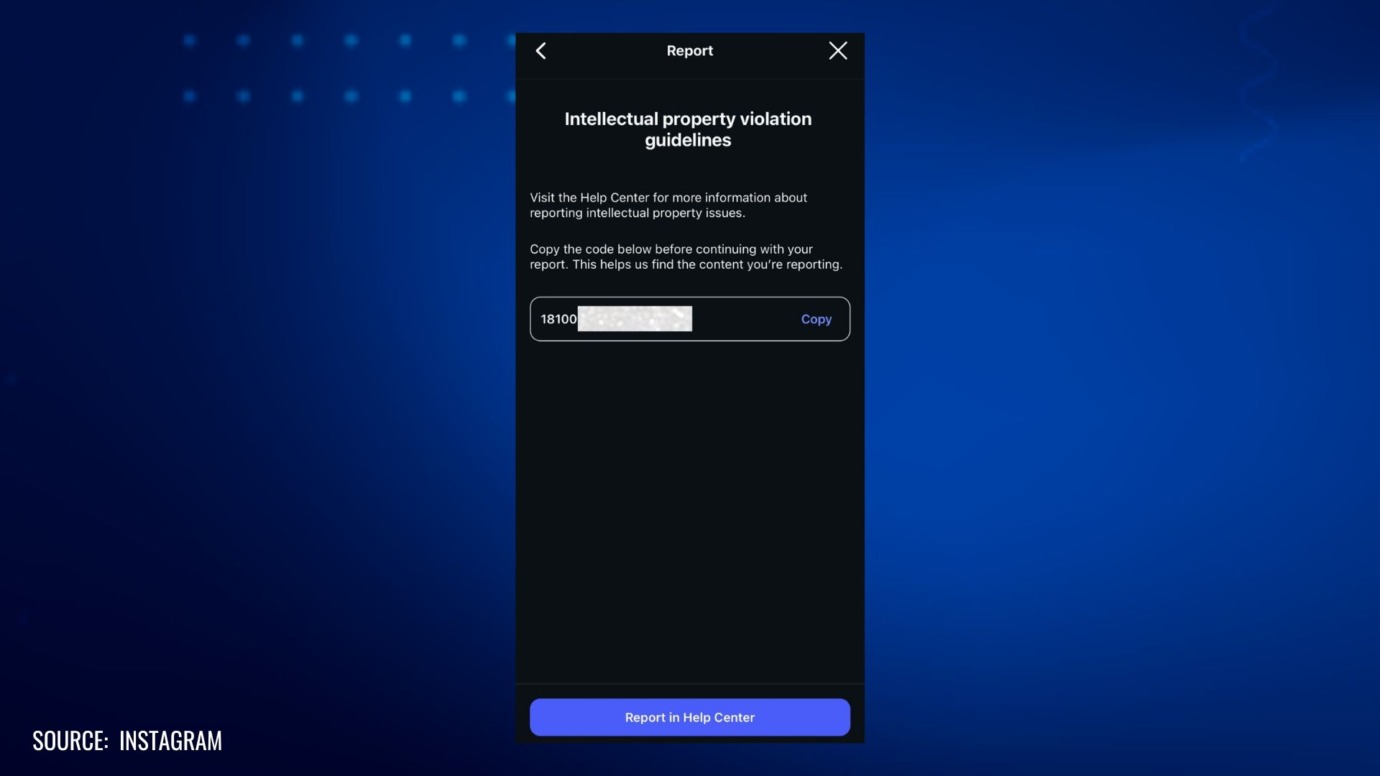
Go to the stolen post and open the menu (the three dots). Select the option related to intellectual property violation. Instagram will walk you through a short series of prompts. At some point during this process, the platform will generate a unique case code. Save it immediately: you will need it to complete the formal copyright report.
Filing the formal copyright report:
Instagram will direct you to their Help Center, where you can submit your full copyright complaint. During this process, you will need to identify your original content, explain how it was used without authorization, and attach the documentation you gathered in Step 1.
When submitted properly, Instagram typically reviews these reports within a few days. If the claim is valid, the infringing content will be removed. The account that posted it may also receive a warning, and repeat violations can result in stronger penalties, including account suspension.
Step 4: File a DMCA Takedown Notice If Reporting Does Not Work
In many cases, Instagram’s internal reporting process resolves the issue. But if it does not, or if the same account continues to steal your content after a report is filed, the next step is a DMCA takedown notice.
What is a DMCA takedown notice?
The Digital Millennium Copyright Act is a U.S. federal law that governs how platforms like Instagram are required to respond to copyright infringement. A DMCA notice is a formal legal notice: not just another internal complaint. When you submit a valid DMCA takedown request, Instagram is legally obligated to act on it. The platform does not have the same discretion it has with a standard report.
What a valid DMCA notice must include:
A DMCA notice must contain several specific elements to be considered valid: a description of the copyrighted work, the location of the infringing content (specific URLs), a statement that you have a good faith belief the use is unauthorized, your contact information, and an electronic signature made under penalty of perjury. Precision matters here. An incomplete or inaccurate notice can delay the process or weaken your position.
Should you file a DMCA notice yourself?
You can submit a DMCA notice on your own through Instagram’s official copyright report form. However, if the content in question is generating revenue, if the infringement has happened more than once, or if you are unsure about any of the required elements, working with legal counsel at this stage is strongly advisable. The legal declarations involved carry real weight. Our team handlesIP enforcement matters like these on a regular basis.
What Happens After the Content Is Removed
In most cases, once Instagram removes the infringing content, the matter is resolved. The infringer typically does not take any further action, especially once they realize that legal consequences are involved.
What if the infringer files a counter-notice?
In some situations, the person who posted the stolen content may file a counter-notification claiming they had the right to use it. If that happens, Instagram will notify you and give you an opportunity to respond. Under the DMCA, if the original claimant does not take legal action within 10 to 14 business days, the platform may restore the content.
This is a point in the process where legal guidance becomes particularly important. An improper response to a counter-notice can result in the content being reinstated, and the situation becoming more complicated than it needed to be. False counter-notices are relatively uncommon, but they do happen, and having proper documentation throughout the process puts you in a much stronger position if one is filed.
How to Reduce the Risk of Future Theft
Enforcement after the fact is important, but preventing theft in the first place is always preferable. There are a few practical steps worth building into your routine.
Monitor your content regularly.
Reverse image and video search tools can help you identify whether your content has been reposted elsewhere. Some services automate this process, scanning across platforms on your behalf. Checking periodically, especially after a video performs well, gives you the best chance of catching theft early, when it is easiest to address.
Leverage your audience.
Your followers and fellow creators often spot stolen content before you do. Multiple reports from different users tend to get faster attention from Instagram than a single complaint. An engaged community is, in many ways, one of the most effective layers of protection available to you.
Consider formal copyright registration.
If you create content professionally or generate meaningful revenue from your videos,registering your copyright with the U.S. Copyright Office is worth the investment. It does not prevent theft, but it significantly strengthens your ability to take legal action if theft does occur.
Need Help Protecting Your Content?
Video theft on Instagram is not something you should have to navigate alone. Our team regularly handles copyright infringement cases involving social media platforms, from initial reporting through legal escalation. If someone has stolen your content and you are unsure of your next step, we are here to help.
Legal Disclaimer: The articles published on our platform are for informational purposes only and do not constitute legal advice in any form. They are not intended to be a substitute for professional legal counsel. For any legal matters, it is essential to consult with us or a qualified attorney who can provide advice tailored to your specific situation. Reliance on any information provided in these articles is solely at your own risk.

 Mar 30, 2026