Book a FREE 15-minute consultation with an expert – Book Now

Amazon Flagged Your Beauty Product as a Medical Device? Here's How to Fix It
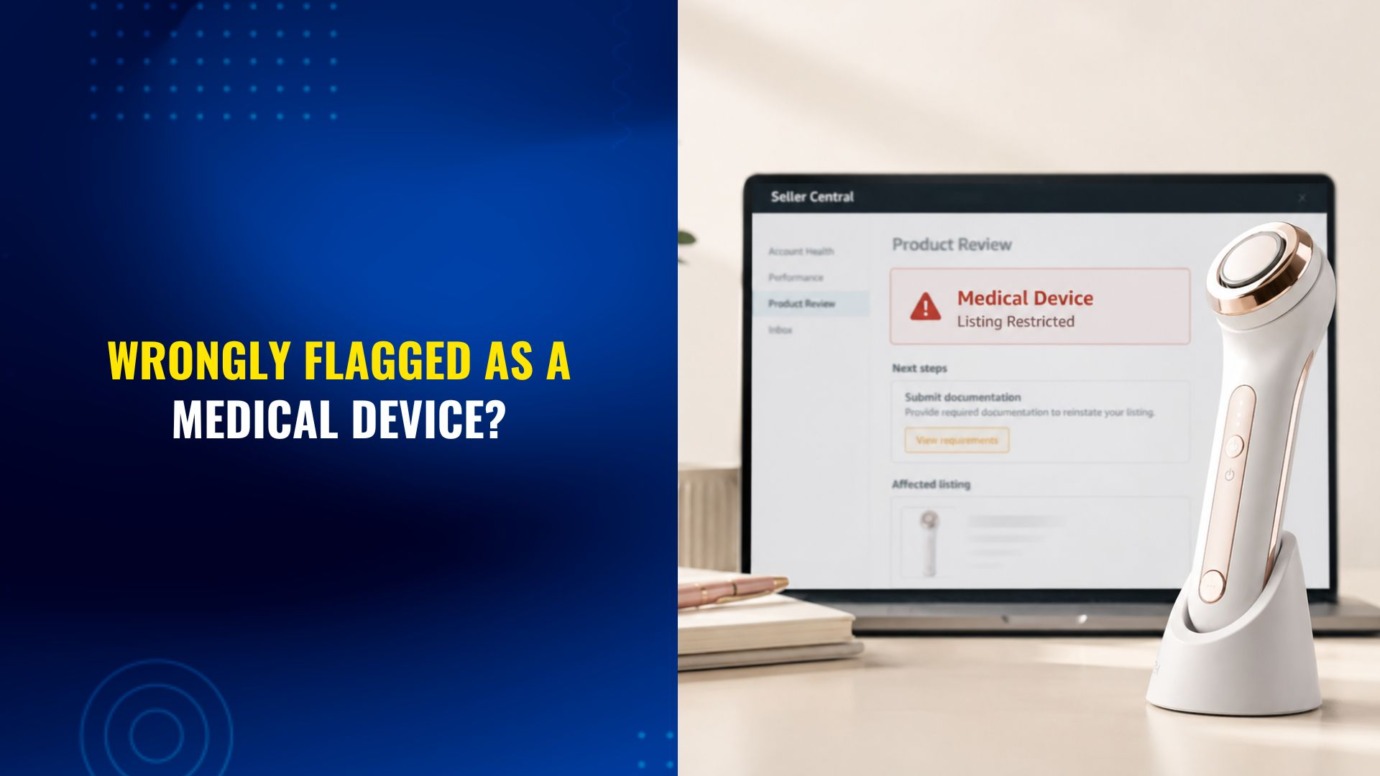
You open Seller Central, and a health or beauty listing is gone. In its place is a message calling your product a “professional-use-only medical device” that requires a 510(k), a clearance number you may never have heard of. If that sounds familiar, you are dealing with one of the most common and frustrating forms of Amazon misclassification.
At Cabilly & Co., we work with Amazon and e-commerce sellers, and this is a case type we handle regularly, from the compliance review that prevents it to the appeal and escalation that resolves it. This article explains why health and beauty products get flagged as medical devices, what actually triggers the flag, and how these cases get resolved.
This is a focused look at one specific version of a broader problem. For the wider picture, see our overview of Amazon product classification and misclassification.
Why Health and Beauty Products Get Flagged So Often
Think about what these products are: a serum, a face massager, an LED skincare device, a facial tool. By their nature, they are used on or for the body. That is exactly the kind of “intended use” that regulators look at when deciding whether something is a medical device.
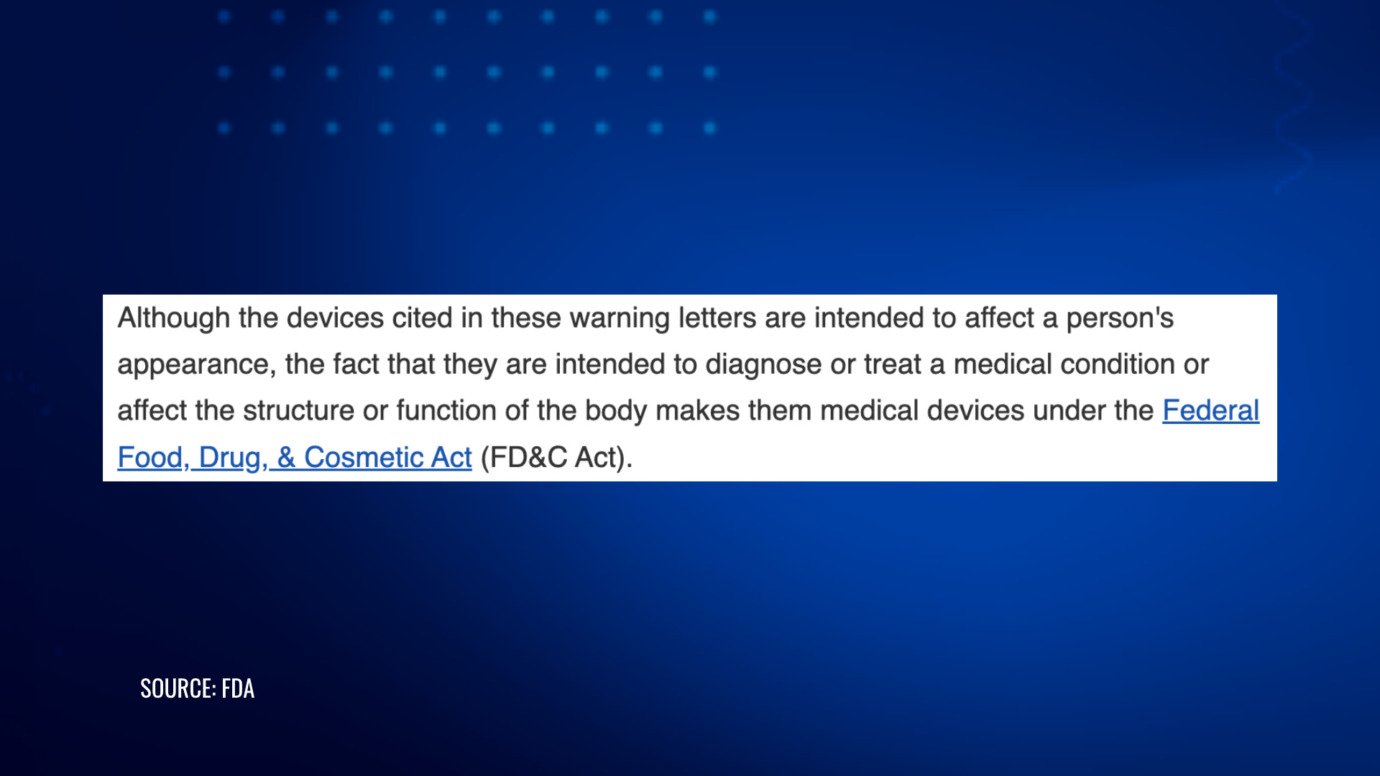
According to the U.S. Food and Drug Administration, a medical device is a product intended to diagnose, treat, prevent, or manage a disease or medical condition. It can also be a product designed to affect the structure or function of the body. Read that last part again. “Affect the structure or function of the body” is a wide net, and health and beauty products live right on the edge of it.
Amazon’s classification system is largely automated. It scans your listing, sees certain words, and makes an estimation. The problem is that the estimation is sometimes wrong, and it is usually triggered by your marketing language more than by the product itself.
How the FDA Actually Classifies Medical Devices
Understanding the real rules matters for your appeal, so here is the short version.
The FDA sorts medical devices into three risk-based groups:
- Class I: lowest risk (many everyday, non-invasive tools)
- Class II: moderate risk
- Class III: highest risk (for example, pacemakers and implants)
Here is the key point many sellers miss. A large share of low-risk devices do not require a 510(k) at all. They’re what the FDA calls “exempt.” As the FDA itself notes, most Class I and some Class II devices are exempt and do not require FDA review before marketing (see the FDA’s guidance on how to determine if your product is a medical device).
The takeaway is simple. Even when a product genuinely is a low-risk device, it very often needs no 510(k). And many products are not medical devices at all. So when Amazon demands a 510(k) number for your face massager, there is a real chance the demand itself comes from a misunderstanding.
One caution: exemption is specific to the device type, not a blanket rule, and small changes to a product’s stated intended use can push it out of an exempt category. This is U.S. federal regulation, and the details are nuanced, which is exactly why these cases can turn on fine points.
What Amazon Claims Your Product Is
The accusations take many forms. We have seen a cosmetic device flagged as a regulated ultrasonic beauty device, a breathing exerciser flagged as a “spirometer” treated as professional-use only, an LED skincare tool labeled a “laser surgical instrument,” and a simple face and neck massager tagged as a “muscle stimulator.”
The system can be extremely sensitive. In cases we are aware of, a listing sat live for over thirty days, the seller swapped out a single product photo, and within minutes the whole listing was flagged as a medical device demanding a 510(k).
So your first move is to find out exactly what Amazon claims your product is. Once you know the specific classification assigned, you can work backward and figure out what caused it.
The Real Cause Is Almost Always Language
This is where most of these cases are won or lost.
Because a product’s status hinges on its intended use, how you label, market, and describe your product carries critical weight. Most misclassifications are triggered by the words and images in a listing. Phrases that imply a medical or therapeutic effect are the usual culprits: “reduces wrinkles,” “stimulates muscles,” “treats” something, “therapeutic.” Even when a product is purely cosmetic, that kind of language tells the algorithm it affects the structure or function of the body, and that alone can trip the wire.
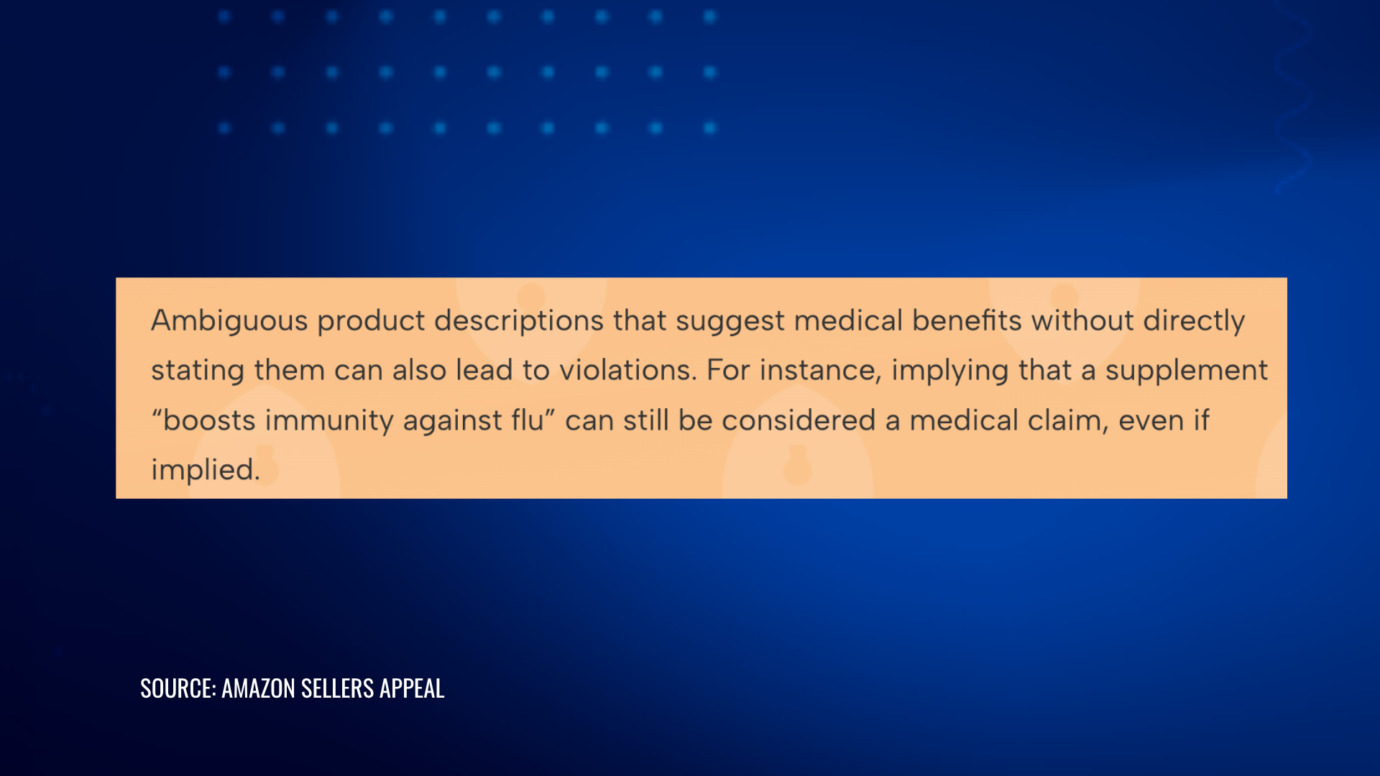
In one case we are aware of, a seller’s packaging said the device supported wrinkle reduction. Amazon’s position was that changing the skin that way implied a medical use, even though the product was clearly cosmetic. A small change to the wording would likely have prevented the classification. The differences, however, can be extremely subtle and far from obvious to a non-expert.
Where the Problem Lives: Listing, Packaging, or Product
Here is a critical distinction that shapes how hard the fix will be.
Sometimes the problem is only in your listing: the title, the bullet points, the A-plus content. That is the better situation, because listing text can be cleaned up.
But sometimes the problematic language is on the product itself or on the packaging. When that happens, Amazon tends to get much stricter and may require you to remove all of your FBA inventory for that ASIN. In some situations, you may even need to create a brand-new ASIN to ship back updated, compliant products.
That is why identifying where the issue lives is the first real step in fixing it.
How to Resolve a Medical Device Misclassification
The general approach is to clean first, then appeal, though how straightforward that is depends on where the problematic language lives and how Amazon responds.
Where the language caused the classification, Amazon often expects the listing, and the product and packaging where relevant, to be fully cleaned before your appeal is taken seriously. So you go through everything: the detail page, the images, the manual, the packaging. You identify the words or claims that triggered the flag, and you fix them. Then you appeal.
Your appeal has to be clear and specific. It needs to explain why the product is not what Amazon says it is and why it belongs on the platform.
- If you found and corrected problematic language, present that as corrective and preventive action.
- If you found nothing wrong, and this is purely an over-aggressive algorithm or a misreading of the rules, present the correct compliance classification and explain it with direct reference to the actual FDA regulations.
In cases that turn on detailed, nuanced points of FDA regulation, a supporting letter from a compliance expert can make a real difference, especially when the case needs to be escalated. This kind of work sits at the heart of our Amazon compliance and regulation service.
Why These Cases Get Stuck
When you appeal, you are usually going back and forth through the case log with an Amazon agent. But that agent is generally just a bridge between you and the team actually reviewing the case. Arguing endlessly in the case log often goes nowhere.
What is frequently needed is a direct escalation to a senior, specialist team. Even then, Amazon can be extremely cautious, or simply immovable. We have worked on cases where a seller went through the long, expensive process of getting a formal classification from the FDA itself, and Amazon still rejected the official document and stuck with its original call. In situations like that, our attorneys have had to contact Amazon’s legal department directly to get the listing reinstated, work that falls under our Amazon legal intervention service.
None of this is meant to discourage you. These cases are often winnable, though outcomes depend on the specific facts, the classification involved, and how Amazon’s review team responds. But the path is not always a single tidy appeal, and knowing that from the start changes how you approach it from day one.
The Best Fix Is Prevention
The best way to handle all of this is to never get here in the first place.
If you are sourcing or manufacturing a new health or beauty product, get a full compliance review before you commit. Have your product, packaging, labeling, and marketing language reviewed by someone who understands both Amazon’s policies and federal regulations.
That review does two things. It helps you avoid a misclassification on Amazon, and it helps you stay compliant with the FDA. Amazon’s rules are one thing, and federal law is another, and you want to be on the right side of both.
One last point to keep in mind: Amazon reserves the right to restrict any product it chooses, regardless of how the FDA classifies it, and its policies change often. Checking those policies regularly is simply part of selling in this category.
Bringing It Together
If your health or beauty product gets flagged as a medical device, it usually comes down to language. Find out exactly what Amazon claims it is. Clean up the listing, and the packaging and product if needed. Then appeal with a clear, specific explanation tied to the actual regulations, and bring in expert support when the case calls for it. If you hit a wall in the case log, escalation is often the only way through.
These situations feel overwhelming, especially when your inventory is sitting at risk. But with the right approach (cleaning the language, building a clear appeal, and escalating when needed) many of these cases do get resolved.
Talk to Us Before You List, or the Moment You Get Flagged
At Cabilly & Co., this is the kind of case we handle regularly, from the compliance review that prevents it to the appeal and escalation that fixes it. If you are dealing with a misclassification right now, or you want your products reviewed before you list them, contact our team. We are happy to help.
PROTECT YOUR BRAND. GROW YOUR BUSINESS.
Rated 4.9 by 80+ clients on Google Reviews

Top 20
Trademark lawyer in the US*
Top 3
Service providers for Amazon sellers*
96%
Success rate for TM registrations
8000+
Clients Worldwide
Legal Disclaimer: The articles published on our platform are for informational purposes only and do not constitute legal advice in any form. They are not intended to be a substitute for professional legal counsel. For any legal matters, it is essential to consult with us or a qualified attorney who can provide advice tailored to your specific situation. Reliance on any information provided in these articles is solely at your own risk.
Read the latest from Cabilly & Co.
 Oct 5, 2026
Amazon Brand Registry – Discover for Free if You’re Eligible
Increase Your Chance of Getting a
Trademark to 96%


STAY UPDATED
Subscribe to Our Newsletter
Sign up to receive valuable information on E-Commerce and intellectual property
Have a legal question?