
Book a FREE 15-minute consultation with an expert – Book Now

What Is Commercial Arbitration?
Commercial arbitration is a private process for resolving business disputes outside of court.
Instead of filing a lawsuit and asking a judge or jury to decide the case, the parties present their dispute to one or more arbitrators. The arbitrator reviews the contract, evidence, witness statements, legal arguments, and other relevant materials, then issues a decision.
For business owners, commercial arbitration often matters because the requirement is already written into a contract before any dispute starts. You may find it in supplier agreements, service contracts, distribution agreements, software agreements, franchise agreements, partnership agreements, operating agreements, licensing agreements, and e-commerce business contracts.
That clause can decide where your dispute is heard, what rules apply, who chooses the arbitrator, what fees you pay, how much evidence you can request, and whether you can go to court at all.
Note that commercial arbitration differs from informal negotiation or mediation. It can be a formal legal process with deadlines, filing fees, evidence, hearings, legal arguments, and a binding result.
That’s why business owners should understand what commercial arbitration means before signing a contract, filing a claim, or responding to one.
Since our team has handled many commercial arbitrations, we will explain when arbitration applies, how the process works, and what your business should consider before moving forward.
When does commercial arbitration apply?
Commercial arbitration usually applies when a business contract includes an arbitration clause.
That clause may state that any dispute arising from the contract must be handled through arbitration rather than in court. In some contracts, the clause may cover only certain disputes. In others, it may apply broadly to almost every disagreement connected to the business relationship.
Businesses can also agree to arbitrate an existing dispute after it arises.
For example, commercial arbitration may apply to disputes involving:
- Contract breaches
- Unpaid invoices
- Failed deliveries
- Vendor or supplier issues
- Partnership disputes
- Licensing disputes
- Franchise disputes
- Service agreement disputes
- Distribution disputes
- Business purchase agreements
- Intellectual property licensing disagreements
- E-commerce and platform-related business conflicts
The first question after a dispute arises is whether the parties agreed to arbitrate it.
If your contract has a valid arbitration clause, you may have limited ability to file a lawsuit in court. You may need to bring the case through the arbitration forum named in the agreement, follow that forum’s rules, and pay the required filing or administrative fees.
This is why you should review arbitration language before you sign, not only after the business relationship breaks down.
What is the difference between commercial arbitration and commercial litigation?
Commercial arbitration and commercial litigation are both ways to resolve business disputes, but they work very differently.
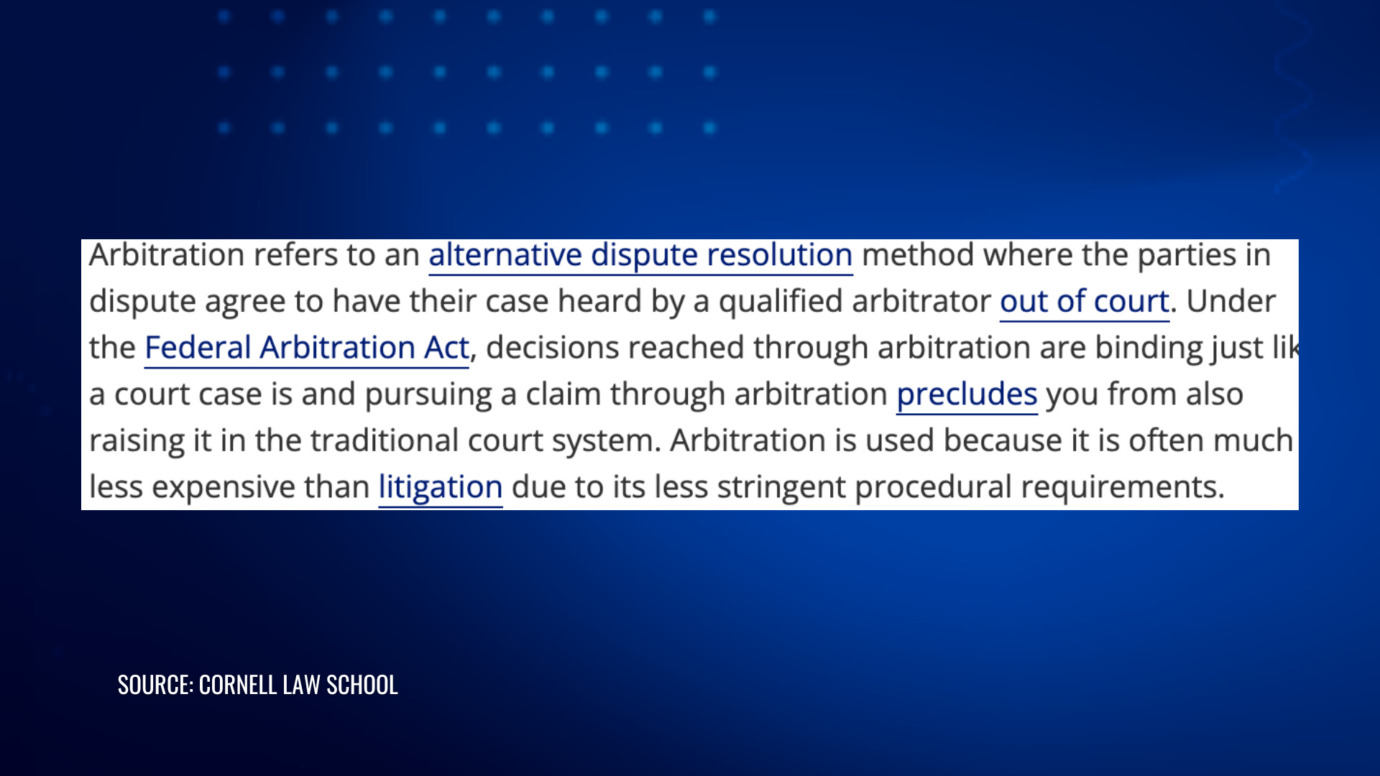
Commercial litigation is the court process. One party files a lawsuit, the case moves through the public court system, and a judge or jury may decide the outcome. Litigation usually follows formal rules of civil procedure and evidence. It may involve pleadings, motions, discovery, depositions, court hearings, settlement conferences, trial, and possible appeals.
Commercial arbitration is a private dispute resolution process. One party files a demand for arbitration, and the dispute is handled by an arbitrator or arbitration panel instead of a judge. The process is usually controlled by the arbitration clause, the chosen arbitration forum, and the rules that apply to the dispute.
The biggest differences usually involve control, privacy, procedure, cost, timing, and appeal rights.
In litigation, the court controls much of the process. In arbitration, the contract and arbitration rules often control the process.
In litigation, filings and hearings are often public. Arbitration proceedings are generally conducted outside the public court system, although confidentiality isn’t always automatic.
In litigation, the parties may have broader discovery rights. In arbitration, discovery may be more limited.
In litigation, the judge is assigned by the court. In arbitration, the parties may have some role in selecting the arbitrator.
In litigation, appeal rights are usually broader. In arbitration, the grounds for challenging an award are often limited.
In arbitration, the parties often pay filing fees, administrative fees, and arbitrator fees, in addition to their own legal fees.
This does not mean arbitration is always cheaper or faster. It depends on the contract, the forum, the dispute amount, the number of arbitrators, the complexity of the evidence, the hearing length, and how aggressively both sides pursue the dispute.
For a small business owner, the key point is simple: arbitration can be more efficient than court, but it’s still a serious legal process. You should not treat it like a casual business conversation.
How does commercial arbitration work?
Commercial arbitration usually follows a structured process. The exact steps depend on the contract, the arbitration provider, and the rules that apply, but many cases move through the following stages:
Review the arbitration clause
The first step is to review the contract. The clause may identify the arbitration forum, location, rules, number of arbitrators, fee structure, confidentiality terms, and whether the award will be binding.
Assess the dispute
Before filing or responding, you need to understand the claim, the amount at stake, the strength of the evidence, the deadlines, the likely costs, and whether settlement makes business sense.
File a demand for arbitration
The party starting the case usually files a written demand for arbitration. This document identifies the parties, explains the dispute, states the claims, and describes the relief requested.
Pay the required filing fees
Most arbitration forums require filing fees or administrative fees. The amount may depend on the size of the claim, the forum, and the applicable rules.
Serve or notify the other party
The opposing party must receive notice of the arbitration. The rules or contract may specify how notice must be given.
Submit a response
The responding party usually files an answer or response. This may deny the claims, raise defenses, assert counterclaims, or challenge whether the dispute belongs in arbitration.
Select the arbitrator
The parties may choose one arbitrator, use a ranking process, or follow the appointment method in the arbitration rules. Some agreements require a three-arbitrator panel, which can increase cost.
Attend a preliminary conference
The arbitrator often holds an initial conference to set deadlines, discuss discovery, schedule hearings, and address procedural issues.
Exchange information and evidence
The parties may exchange contracts, invoices, emails, records, witness statements, expert materials, or other documents. Arbitration discovery is often narrower than court discovery, but it can still be important.
File motions or briefs
Depending on the case, the parties may submit legal briefs, procedural requests, dispositive motions, or pre-hearing statements.
Attend the arbitration hearing
At the hearing, each side presents evidence, witnesses, and arguments. The hearing may be in person, virtual, or based on written submissions, depending on the rules and the dispute.
Receive the arbitration award
After the hearing, the arbitrator issues a decision. This is usually called an award. Depending on the arbitrator’s authority and the applicable rules, the award may grant monetary or other relief.
Confirm or enforce the award if necessary
If the losing party does not comply, the winning party may need to ask a court to confirm or enforce the arbitration award.
The process can look simpler than litigation, but it still requires preparation. A weak filing, missing evidence, poor contract analysis, or missed deadline can hurt your position.
Is commercial arbitration legally binding?
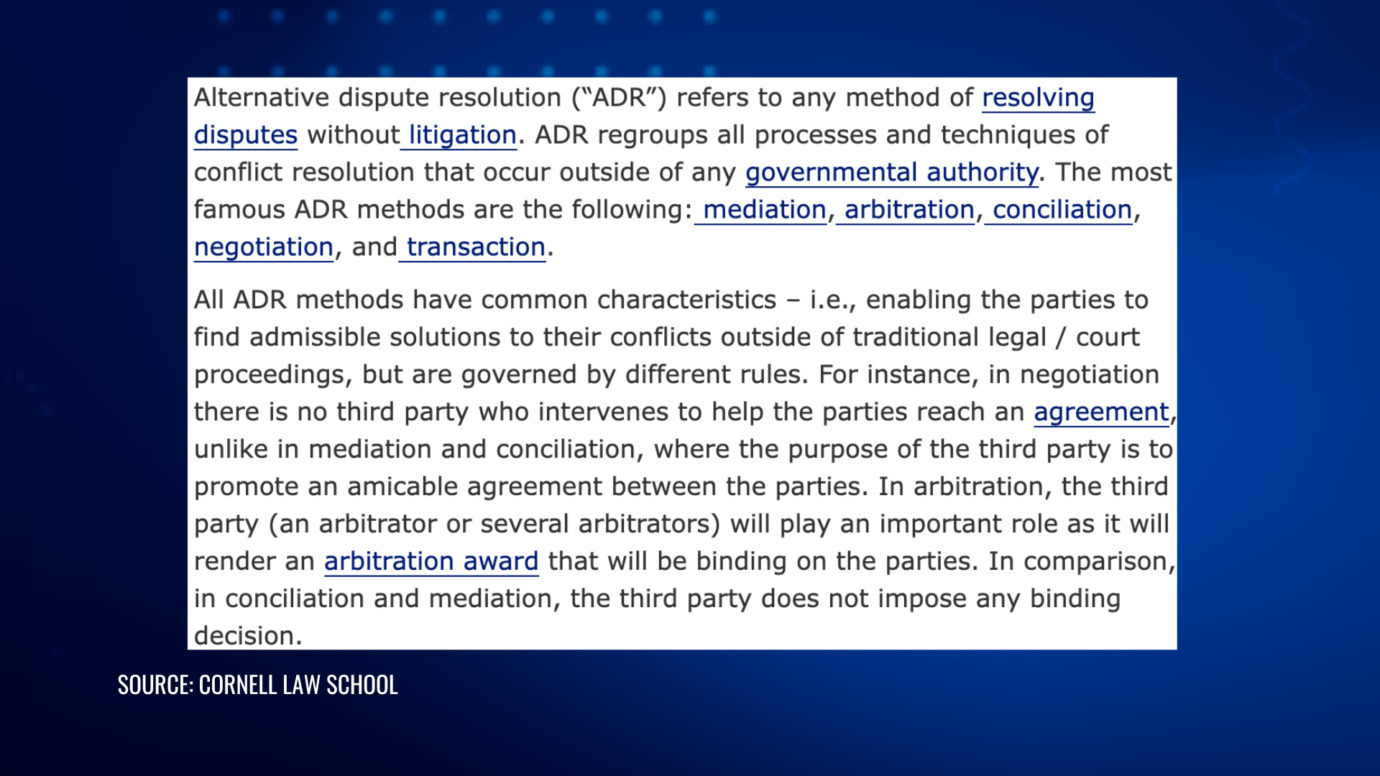
Commercial arbitration is often binding, depending on the parties’ agreement and the rules that apply.
In many business contracts, arbitration isn’t just an optional discussion. It’s the required process for resolving disputes. Once the arbitrator issues an award, the losing party may have limited options to challenge it.
That’s one of the biggest differences between arbitration and mediation.
Mediation is a settlement process. A mediator helps the parties discuss the dispute and look for a possible resolution, but the mediator does not decide the case.
Arbitration is different. An arbitrator can decide the case. If the arbitration is binding, the award may be enforceable in court.
This matters because some business owners enter arbitration thinking they will get a second chance in court if they lose. That’s often not true. Courts generally do not treat arbitration awards like ordinary trial decisions that can be appealed just because one side disagrees with the result.
Depending on the governing law, there may be limited grounds to ask a court to vacate, modify, or correct an award, but those grounds are generally narrow.
That means you need to treat arbitration seriously from the beginning.
What types of business disputes go to commercial arbitration?
Commercial arbitration can apply to many types of business disputes.
Common examples include disputes over payment, delivery, performance, termination, ownership rights, contract interpretation, business obligations, and damages.
For example, a business may face commercial arbitration when:
- A supplier fails to deliver goods on time
- A vendor claims the client failed to pay
- A distributor violates territory restrictions
- A service provider fails to meet contract requirements
- A franchise relationship breaks down
- A business partner claims another partner breached the operating agreement
- A buyer and seller dispute the terms of a business acquisition
- A licensing agreement creates a conflict over royalties or usage rights
- A contractor and business owner disagree over project performance
- An e-commerce business has a contract dispute with a service provider, agency, consultant, logistics partner, or manufacturer
- An Amazon seller claims a manufacturer failed to meet agreed product specifications
- A brand owner and licensing partner disagree over the permitted use of a trademark
The dispute does not need to be dramatic to become expensive. A poorly drafted contract, unclear scope of work, missed payment, or vague termination clause can create a serious arbitration case.
For small businesses, the risk is not only losing the dispute. The risk is spending time and money on a process you did not fully understand when you signed the contract.
What cannot be fully resolved through commercial arbitration?
Not every dispute or remedy can be handled entirely through commercial arbitration.
Whether arbitration can resolve a particular issue depends on the arbitration agreement, governing law, parties involved, applicable rules, and type of relief being requested. In some cases, a court or government agency may still need to act.
For example, commercial arbitration may not fully resolve:
Criminal charges
Private parties cannot use commercial arbitration to decide criminal guilt or punishment. Criminal matters belong to government authorities and the courts.
Certain regulatory enforcement actions
A private arbitration agreement generally cannot prevent a government agency from carrying out its own enforcement authority.
Certain public law issues
Some disputes affect rights or legal interests beyond the private contract between the parties. These issues may require court or agency involvement.
Certain requests for emergency relief
Some disputes require immediate action to preserve assets, stop ongoing conduct, or maintain the status quo. Depending on the arbitration agreement, applicable rules, and governing law, a business may be able to seek emergency relief from an arbitrator, an emergency arbitrator, or a court.
Disputes involving parties who may not be bound by the arbitration agreement
Arbitration is generally based on agreement. If a person or company did not sign the contract, a dispute may arise over whether that party can be required to arbitrate or can enforce the arbitration clause. The answer depends on the facts and applicable law.
Certain bankruptcy-related disputes
A bankruptcy filing can complicate whether and how an arbitration proceeds. Some disputes may remain subject to arbitration, while others may require action or approval from the bankruptcy court. The answer depends on the type of claim and the circumstances of the bankruptcy case.
Certain intellectual property actions and remedies
Many intellectual property disputes can be arbitrated, including disputes over licensing agreements, royalties, ownership obligations, and contractual use rights. However, some remedies involving trademark or patent registration, cancellation, government records, rights against third parties, or broader public effects may still require action before a court or government agency.
Claims where the arbitration clause is invalid or unenforceable
If the clause was not properly formed, does not cover the dispute, violates applicable law, or is otherwise unenforceable, arbitration may not apply.
This is why the contract language matters. A broad arbitration clause can pull many disputes into arbitration. A narrow clause may cover only specific issues.
Before assuming that a dispute must go to arbitration, you need to review the contract, the governing law, the parties involved, and the remedy you need.
What should you check before agreeing to commercial arbitration?
Before signing a contract with a commercial arbitration clause, you should understand what the clause actually requires.
Do not focus only on the business terms and ignore the dispute resolution section. That section may become one of the most important parts of the contract if the relationship breaks down.
You should check:
Which arbitration forum applies
The contract may name a specific arbitration provider or set of rules. That choice can affect filing requirements, fees, procedures, deadlines, and arbitrator selection.
Where the arbitration will happen
The location matters. If the contract requires arbitration in another state or country, travel and legal costs may increase.
Which law applies
The governing law clause can affect how the contract is interpreted and what claims or defenses may be available.
How many arbitrators will decide the case
A three-arbitrator panel may be appropriate for larger disputes, but it can be expensive for smaller business conflicts.
Who pays the fees
The clause may address filing fees, administrative fees, arbitrator fees, attorney’s fees, and costs. If it does not, the forum rules or governing law may control.
Whether the award is final and binding
You should know whether you are giving up the right to a court trial and whether the grounds for challenging the award are limited.
Whether emergency relief is available
If your business may need an injunction or another urgent form of relief, the clause and applicable arbitration rules should be reviewed carefully.
Whether confidentiality applies
Arbitration is generally conducted outside the public court system, but confidentiality is not always automatic in every respect. The clause should be clear if confidentiality matters.
What claims are covered
Some clauses cover all disputes connected to the contract. Others cover only specific claims. This can affect whether related disputes must be split between arbitration and court.
Whether class or collective claims are limited
Some arbitration clauses limit class, collective, or consolidated proceedings. This can matter in consumer, employment, franchise, platform, and multi-party business disputes.
Whether the clause fits the size of the deal
A complex arbitration clause may be reasonable for a major commercial agreement but burdensome for a smaller contract. The dispute process should make business sense for the value of the relationship.
A contract can look favorable on price, scope, or payment terms while quietly creating a costly dispute process. You need to know that before you sign.
Where can I get legal help with commercial arbitration?
Legal help with commercial arbitration is guidance on what your arbitration clause requires, whether the dispute belongs in arbitration, and what options make sense for your business. It may include reviewing the contract, identifying the applicable rules, preparing a demand or response, organizing evidence, and managing deadlines.
Arbitration is not always the best path. Depending on the dispute, negotiation, mediation, or another legal option may make more sense. The goal is simple: understand the process and your options before the dispute consumes more time, money, and attention than it should.
Contact us today if your contract includes an arbitration clause or you are already facing a commercial arbitration dispute.
PROTECT YOUR BRAND. GROW YOUR BUSINESS.
Rated 4.9 by 80+ clients on Google Reviews

Top 20
Trademark lawyer in the US*
Top 3
Service providers for Amazon sellers*
96%
Success rate for TM registrations
8000+
Clients Worldwide
Legal Disclaimer: The articles published on our platform are for informational purposes only and do not constitute legal advice in any form. They are not intended to be a substitute for professional legal counsel. For any legal matters, it is essential to consult with us or a qualified attorney who can provide advice tailored to your specific situation. Reliance on any information provided in these articles is solely at your own risk.
Read the latest from Cabilly & Co.
 Oct 5, 2026
Amazon Brand Registry – Discover for Free if You’re Eligible
Increase Your Chance of Getting a
Trademark to 96%


STAY UPDATED
Subscribe to Our Newsletter
Sign up to receive valuable information on E-Commerce and intellectual property
Have a legal question?