
Book a FREE 15-minute consultation with an expert – Book Now

What Is Intellectual Property Arbitration?
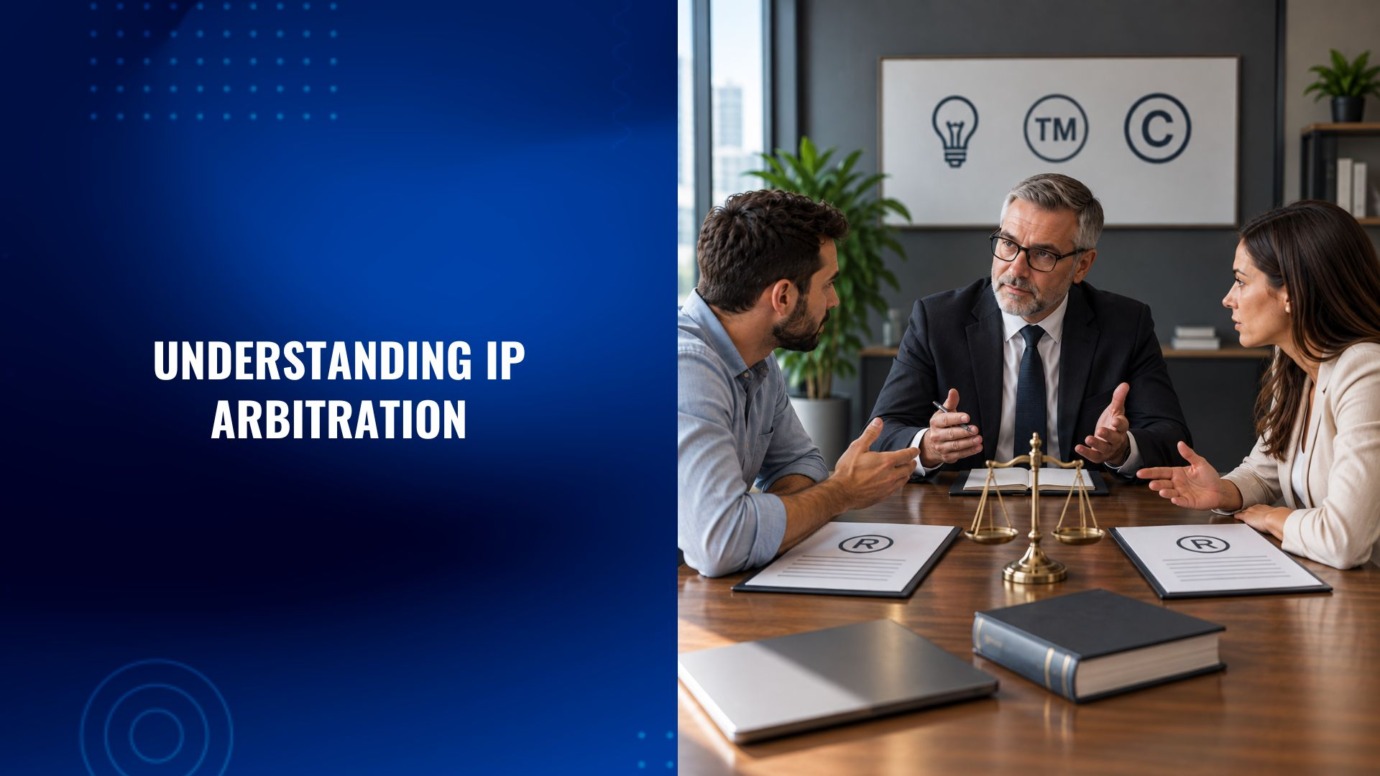
Intellectual property arbitration is a private legal process used to resolve trademark, copyright, patent, licensing, and business IP disputes outside traditional court litigation.
Nowadays, your business faces higher stakes from stricter regulatory scrutiny, rising brand disputes, increased content ownership issues, and more complex vendor relationships.
Our team has helped many small business owners resolve these disputes through arbitration strategy, legal negotiation, and practical IP protection planning.
In this blog, we’ll share key insights on how arbitration can help you overcome these challenges and protect your business’s most valuable assets.
What is an IP dispute?
An IP dispute is a legal conflict over who owns, controls, uses, licenses, sells, copies, or enforces intellectual property. For you as a small business owner, these disputes can involve trademarks, copyrights, patents, product designs, brand names, logos, website content, marketing materials, packaging, software, or claims that your business copied another company’s protected work.
In simple terms, an IP dispute happens when someone says your business used protected intellectual property without permission, or when you need to stop another party from using intellectual property that belongs to you.
Common examples include:
- A competitor claims your brand name or logo is too similar to theirs
- A former business partner claims ownership over your company name or creative assets
- A designer, agency, or freelancer claims they still own your logo, website copy, or product images
- A supplier or distributor says you do not have permission to sell or market certain products
- A licensing partner claims you used their intellectual property outside the agreed terms
- Your business receives a patent complaint tied to product design, function, or technology
- A copyright owner claims your website, ads, photos, packaging, or videos copied their work
For your business, the danger is not limited to the legal dispute itself. An IP complaint can affect your website, advertising, product sales, vendor relationships, licensing rights, investor confidence, and brand reputation.
That is why IP disputes need to be treated as both legal problems and business problems. You may need to resolve the legal claim while also protecting your revenue, operations, customer trust, and long-term brand value.
When should you consider IP arbitration?
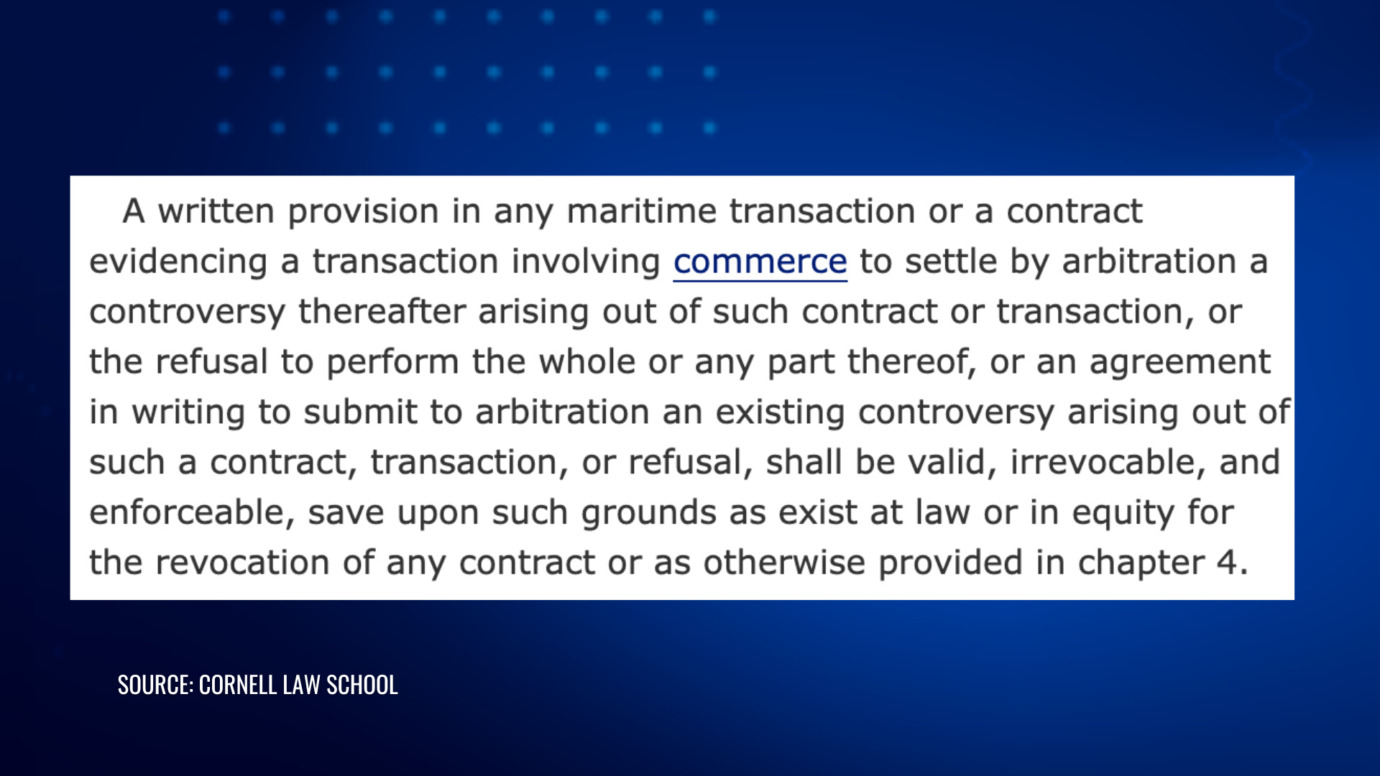
You should consider IP arbitration when the dispute involves a legal relationship, contract, licensing agreement, partnership agreement, vendor agreement, supplier agreement, distribution agreement, settlement agreement, or other arbitration clause that allows the dispute to be decided outside court.
Arbitration may be appropriate when both sides have agreed to it in writing. This agreement may appear in a business contract, partnership agreement, licensing deal, supplier agreement, service agreement, franchise agreement, distribution agreement, or settlement document.
You may need to consider arbitration when:
- A competitor accuses your business of trademark infringement
- A former partner claims ownership of your brand, logo, product, or business assets
- A licensing partner claims your business exceeded the license terms
- A supplier or distributor blocks you from using a brand name or product materials
- A freelancer, designer, developer, or agency claims ownership over work your business paid for
- A private label or product dispute involves ownership or control of IP
- A settlement agreement requires arbitration for future disputes
- A legal claim threatens your sales, contracts, customer relationships, or brand reputation
Arbitration can be especially important when speed and privacy matter. Court litigation can become public, expensive, and slow. Arbitration can sometimes create a more focused process for resolving the dispute, especially when the issue turns on contracts, ownership documents, licensing rights, and evidence.
For your business, timing matters. The longer an IP dispute remains unresolved, the more damage it can cause to revenue, vendor relationships, marketing campaigns, product launches, and brand credibility.
How does an IP arbitration process work?
An IP arbitration process usually begins when one party files a demand for arbitration based on an arbitration agreement. The dispute is then assigned to a neutral arbitrator or arbitration panel, and both sides present evidence, arguments, and legal positions.
The exact process depends on the contract, the arbitration forum, and the rules that apply. However, most IP arbitration matters follow this general path:
1. The parties confirm the arbitration agreement
The first step is to identify the arbitration agreement. This matters because arbitration is usually based on consent. If there is no valid arbitration clause or written agreement, your dispute may need to be handled through court, negotiation, mediation, direct settlement, or another legal process.
2. One party files a demand for arbitration
The claimant files a demand for arbitration. This document explains the dispute, the legal claims, the relief requested, and the basis for arbitration.
3. The other party responds
The response may deny liability, challenge the arbitration demand, raise defenses, or bring counterclaims.
4. An arbitrator is selected
Depending on the rules, the parties may agree on one arbitrator, select from a list, or use an arbitration organization’s appointment process.
5. Both sides exchange evidence
In IP disputes, evidence may include trademark registrations, copyright records, patent documents, licensing agreements, vendor contracts, product samples, design files, website screenshots, marketing materials, emails, purchase orders, invoices, and chain of title documents.
6. The arbitrator reviews the case
The arbitrator may hold hearings or decide the matter based on written submissions. Some disputes require live testimony. Others can be decided through documents and legal briefing.
7. The arbitrator issues an award
Depending on the agreement and applicable law, and only where that agreement and law authorize it, the award may require payment, stop certain conduct, confirm ownership rights, enforce a license, assign rights, or resolve contract-based claims.
For you, the legal result is only one part of the strategy. If the dispute affected your sales, vendor relationships, marketing, product launches, or brand reputation, the arbitration outcome may also need to be used in settlement implementation, contract updates, licensing corrections, or broader brand protection planning.
What types of intellectual property disputes can arbitration resolve?
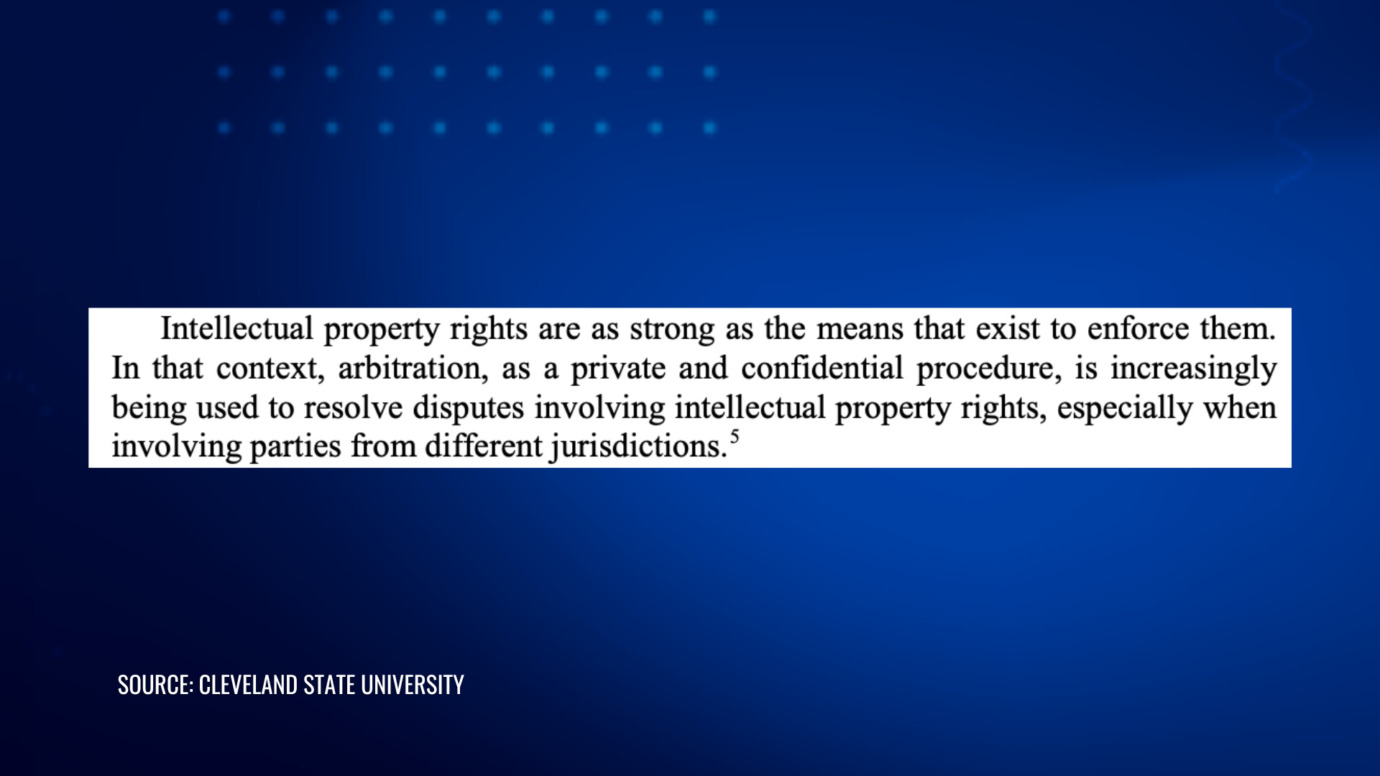
IP arbitration can resolve many private disputes involving ownership, licensing, infringement, contract rights, brand control, product rights, content rights, and business relationships when the parties have agreed to arbitrate.
Common types of IP disputes that may be handled through arbitration include:
Trademark disputes
A trademark arbitration may involve your business name, logo, slogan, product packaging, service name, or confusion between two marks. These disputes often arise when a competitor claims your brand name is too similar, a former partner claims rights to the name, or a licensing agreement restricts how the mark can be used.
Copyright disputes
A copyright arbitration may involve your product photography, website copy, blog content, ad creatives, videos, packaging artwork, manuals, software, digital assets, or other creative materials used by your business. These disputes often turn on who created the content, who owns it, and whether your business had permission to use it.
Patent disputes
A patent arbitration may involve the design, structure, function, process, or technology behind your product. Patent disputes can be especially serious because they may affect your ability to manufacture, sell, license, or improve a product line.
Licensing disputes
A licensing arbitration may involve a written agreement allowing your business to use another party’s intellectual property, or allowing another party to use yours. These cases often focus on whether the license terms were followed, whether required fees were paid, whether the IP was used in approved channels, or whether someone continued using IP after the agreement ended.
Vendor and contractor disputes
A vendor or contractor arbitration may involve whether a freelancer, designer, developer, marketing agency, manufacturer, or consultant transferred ownership of the work they created for you. This is common when your business pays for a logo, website, packaging design, app, software, product photography, or brand materials but the contract does not clearly assign IP rights.
Brand ownership disputes
A brand ownership arbitration may involve founders, partners, agencies, manufacturers, investors, employees, or former contractors who disagree over who owns the brand, trademark, content, product design, customer assets, domain names, or creative materials connected to your business.
 Can IP arbitration help protect your business from lawsuits or disruption?
IP arbitration can help protect your business when the underlying issue is a legal dispute that can be resolved through arbitration, settlement, or a rights agreement. However, arbitration does not automatically fix every business consequence unless the right parties are involved and the award can be enforced.
This distinction is critical.
You might assume that winning an IP dispute automatically fixes the entire problem. That is not always true. You may still need to update contracts, correct ownership records, revise licensing terms, remove disputed materials, negotiate with vendors, notify partners, or repair customer-facing damage.
In practice, IP arbitration may support business recovery by producing:
- A settlement agreement
- A formal confirmation of ownership or permitted use
- A licensing clarification
- A written agreement assigning IP rights
- A requirement that one party stop using disputed IP
- A payment award or damages award
- Evidence that a claim was mistaken or unsupported
- A basis for contract updates or future risk reduction
For example, if a former designer claims ownership of your business logo, arbitration may help determine whether your business owns the logo, whether the designer retained any rights, or whether a formal assignment is needed. If the outcome supports your business, that result can help you continue using the brand with more confidence.
Cabilly & Co. approaches these matters with both sides in mind: the legal dispute and the business consequence. For you, resolving the rights issue is often only half the battle. The other half is making sure your business can keep operating without repeat disputes, unclear ownership, or avoidable legal exposure.
What evidence do you need for an IP arbitration case?
You need evidence that proves ownership, authorization, product authenticity, lawful use, contractual rights, and business history. In IP arbitration, the strongest position usually belongs to the party with the cleanest records.
Evidence may include:
- Trademark registration or applications
- Copyright registrations or creation records
- Patent documents or design records
- Licensing agreements
- Partnership agreements
- Vendor and contractor agreements
- Work-for-hire agreements
- IP assignment agreements
- Supplier contracts
- Invoices and purchase orders
- Product authenticity documents
- Manufacturing records
- Chain of title documents
- Domain registration records
- Website screenshots
- Marketing and packaging files
- Complaint letters or demand letters
- Email and message history
- Settlement communications
- Prior permissions or approvals
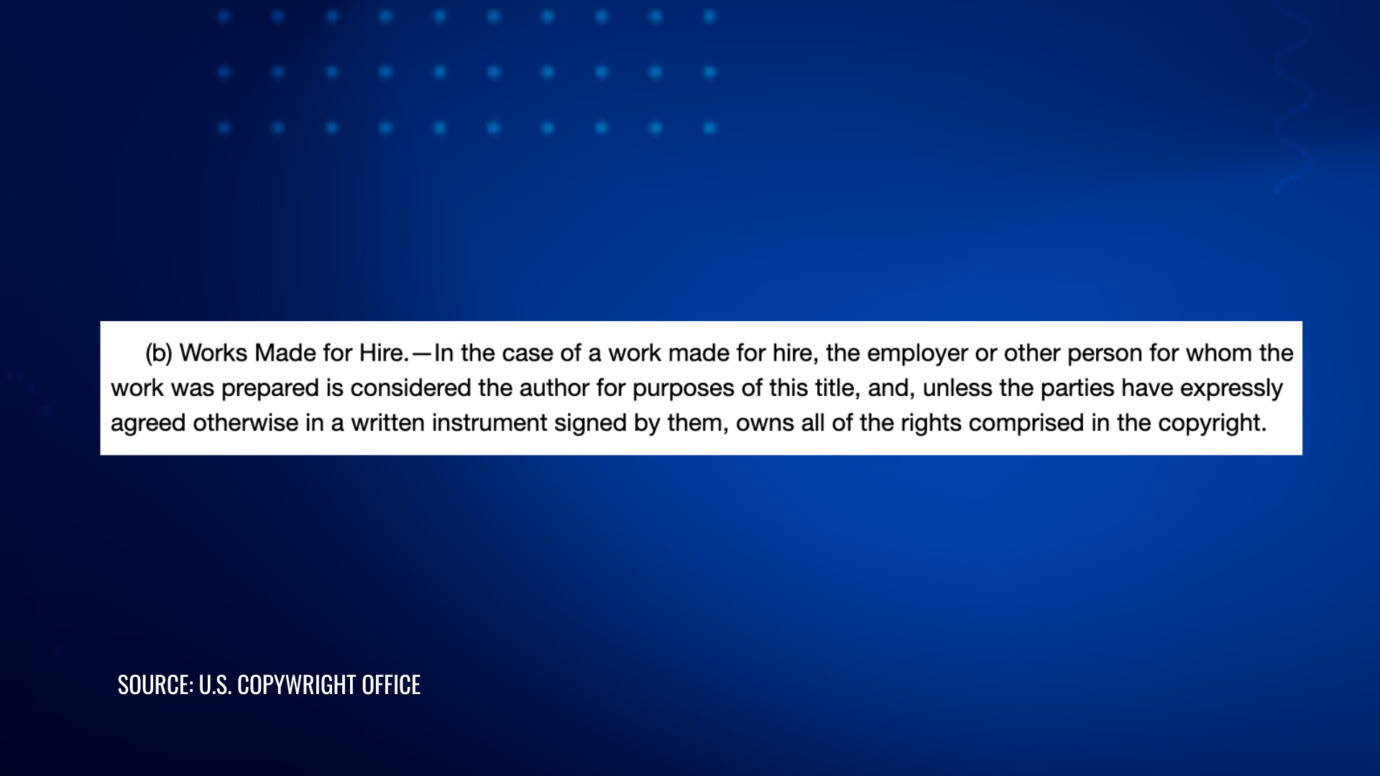
For small business owners, vendor and contractor documentation is especially important. If your business is accused of misusing a logo, website, content, software, packaging, product photography, or creative work, you may need to prove that the work was properly assigned, licensed, or authorized.
This is where many businesses get hurt. You may pay for creative work, product development, branding, or marketing materials, but the contract may not clearly say who owns the intellectual property. By the time a dispute happens, emails may be incomplete, invoices may not show ownership, and your business may not have enough proof to resolve the claim quickly.
A strong evidence file should show the full story: who created the IP, who paid for it, who owned it, who had permission to use it, how it was used, what contract controlled the relationship, and why your business’s use was lawful.
In 2025 and 2026, documentation became even more important for businesses. The FTC raised several maximum civil penalty amounts to more than $53,000 in 2025, and USPTO trademark fee changes took effect in January 2025. For you, the message is clear: legal and brand disputes are becoming more evidence-driven, and clean documentation can affect both the legal strategy and the business recovery strategy.
What are the things IP arbitration can’t settle?
IP arbitration cannot settle every intellectual property or business problem. It is a useful legal tool, but it has limits.
IP arbitration usually cannot settle:
- Disputes where the parties never agreed to arbitrate
Arbitration is usually based on consent. If there is no valid arbitration clause or written arbitration agreement, you may not be able to force the other party into arbitration. - Issues involving parties who are not part of the arbitration
Arbitration generally cannot bind companies, individuals, agencies, or platforms that are not parties to the case. If a vendor, platform, government agency, or third party is not part of the arbitration, the arbitrator’s decision may not automatically require that party to act. - Government enforcement or regulatory matters
Some disputes involving regulatory violations, criminal conduct, customs enforcement, consumer protection issues, or agency action may need to be handled through courts, government agencies, or administrative processes. - Trademark, patent, or copyright registration decisions
Arbitration may resolve private rights between parties, but it does not replace the USPTO, U.S. Copyright Office, or other government agencies. For example, arbitration may clarify who has rights under a contract, but separate agency action may still be needed to register, cancel, or challenge certain IP rights. - Emergency court relief
Some cases require immediate court action, such as a temporary restraining order, preliminary injunction, asset freeze response, or emergency order. Arbitration may still be relevant later, but urgent court strategy may need to come first. - Business consequences involving outside parties
Arbitration does not automatically repair every business consequence tied to the dispute. You may still need to update contracts, revise marketing materials, negotiate with platforms, notify partners, or resolve related issues with customers, suppliers, or agencies. - Cases with weak or missing evidence
Arbitration cannot fix a lack of proof. If you cannot show ownership, authorization, authenticity, lawful use, or contract rights, arbitration may not solve the underlying dispute.
For you as a small business owner, the practical takeaway is simple: arbitration is not a universal reset button. It can be powerful when the dispute is legally arbitrable, evidence is strong, and the result can support business recovery.
How is IP arbitration different from filing a lawsuit?
IP arbitration is usually private, contract-based, and decided by an arbitrator. Lawsuits are filed in court, follow public court procedures, and are decided by a judge or jury.
The biggest difference is control. In arbitration, the parties often have more control over the forum, rules, timeline, confidentiality, and decision-maker. In litigation, the process is governed by court rules and public procedure.
Arbitration may be faster than litigation, but not always. The timeline depends on the complexity of the dispute, the forum rules, the arbitrator’s availability, and how aggressively each side fights.
Arbitration is also usually more private. This can matter for you because public litigation may expose revenue information, vendor relationships, product plans, customer details, internal communications, and brand strategy.
Court litigation may be more appropriate when your business needs emergency relief, wants to bind third parties, needs court enforcement power, or is facing a federal lawsuit, TRO, asset freeze, or injunction.
In some disputes, your business may need both strategies. A court case may involve urgent injunctive relief, while arbitration may apply to contract-based claims between specific parties.
The right path depends on the contract, the IP rights involved, the business consequences, the urgency, and the evidence.
How long does intellectual property arbitration usually take?
Intellectual property arbitration can take several months to more than a year, depending on the complexity of the dispute, the number of parties, the arbitration rules, the evidence involved, and whether the case settles early.
A straightforward licensing or ownership dispute may move faster if the documents are clear and both sides are open to settlement. A complex patent, trademark, copyright, or multi-party business dispute may take longer, especially if it requires expert testimony, technical analysis, product testing, valuation issues, or extensive document exchange.
For you as a small business owner, the legal timeline may feel too slow because business damage can happen immediately. A product launch can be delayed. A website can be taken down. A vendor relationship can break. A brand campaign can stop. Customers can become confused while the legal dispute is still being evaluated.
That is why you should not wait for the final arbitration award before thinking about operational strategy. In many cases, legal counsel should evaluate whether a parallel business action is needed, such as a temporary license, settlement negotiation, contract update, demand response, rebrand analysis, or documentation package.
The goal is not only to win the legal dispute. The goal is to reduce business damage while the dispute is being resolved.
What should you do before starting IP arbitration?
Before starting IP arbitration, you should confirm whether arbitration is available, identify the legal claims, preserve evidence, assess business impact, and determine whether settlement, mediation, court action, contract updates, or arbitration is the best path.
Take these steps before moving forward:
- Review the contract or agreement
Look for an arbitration clause. Check what forum applies, what rules apply, where arbitration must occur, what law governs, and whether emergency relief is allowed. - Identify the actual IP issue
You need to know whether the dispute involves trademark, copyright, patent, trade secret, licensing, ownership, contractor rights, product rights, software rights, or another legal issue. - Preserve every document
Do not delete emails, vendor messages, invoices, contracts, design files, website screenshots, packaging files, product records, marketing materials, or communications with the complaining party. - Assess the business damage
Determine whether the dispute has affected sales, contracts, vendor relationships, customer communications, product launches, marketing campaigns, investor discussions, website access, or brand reputation. - Avoid careless admissions
Be careful about messaging the opposing party, vendor, contractor, competitor, or platform without legal review. A rushed response can make the dispute harder to resolve. - Build an evidence timeline
A timeline helps show when the IP was created, who paid for it, who approved it, when your business received permission, when the dispute started, and how the parties responded. - Speak with counsel before filing
Arbitration can be strategic, but it can also be expensive and binding. You should understand the strength of the case, likely defenses, business risks, settlement options, and operational consequences before starting.
How can you protect your business during intellectual property arbitration?
To ensure your business gets through an IP arbitration, you need to identify what the claim is really about, whether arbitration applies, what evidence you need, and what must happen to preserve your revenue, brand assets, contracts, vendor relationships, and long-term operations.
The goal is not just to win a legal argument but to preserve your brand, reduce disruption, and move forward with stronger documentation and clearer ownership rights as well.
Our team has worked with many businesses going through this process, and we understand how quickly an IP dispute can move from a legal issue to a business problem.
Contact us today if you’re going through IP arbitration and need help protecting your business.
PROTECT YOUR BRAND. GROW YOUR BUSINESS.
Rated 4.9 by 80+ clients on Google Reviews

Top 20
Trademark lawyer in the US*
Top 3
Service providers for Amazon sellers*
96%
Success rate for TM registrations
8000+
Clients Worldwide
Legal Disclaimer: The articles published on our platform are for informational purposes only and do not constitute legal advice in any form. They are not intended to be a substitute for professional legal counsel. For any legal matters, it is essential to consult with us or a qualified attorney who can provide advice tailored to your specific situation. Reliance on any information provided in these articles is solely at your own risk.
Read the latest from Cabilly & Co.
 Oct 12, 2026

Amazon Brand Registry – Discover for Free if You’re Eligible
Increase Your Chance of Getting a
Trademark to 96%


STAY UPDATED
Subscribe to Our Newsletter
Sign up to receive valuable information on E-Commerce and intellectual property
Have a legal question?